Broadcasting Into the Dark: The Podcasters Who Only Speak to the Sleepless
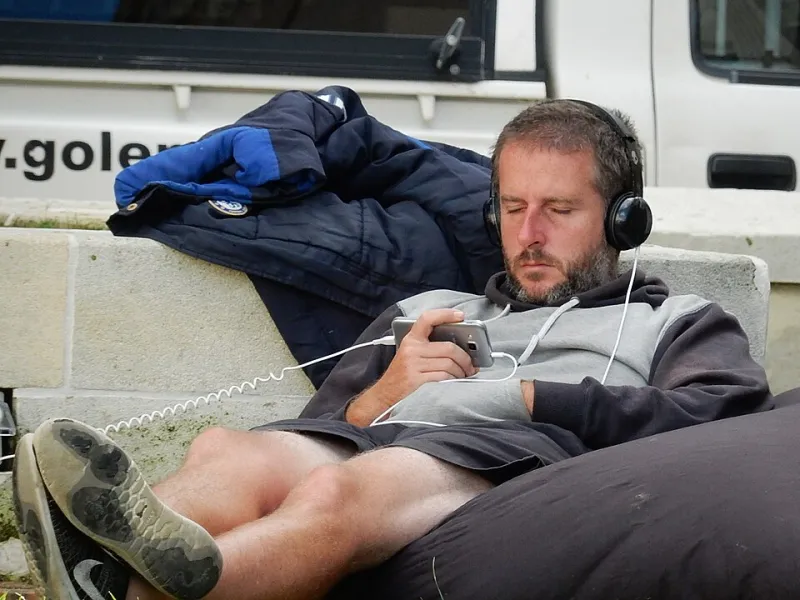
Photo: Michael Coghlan from Adelaide, Australia, CC BY-SA 2.0, via Wikimedia Commons
It's 3:17 in the morning. You're either working a shift that ends at dawn, staring at the ceiling because your brain refuses to cooperate, or you're somewhere in the particular fog that exists between those two states. You put your earbuds in. You don't want news. You don't want comedy. You don't want anything that requires you to be fully present or fully awake.
You want someone to talk to you like you're already half-gone.
A growing number of podcast creators have figured this out — and built entire audiences around it.
The 2 AM Listener Is a Specific Person
Most podcast advice tells creators to record like they're talking to a friend over coffee. Upbeat. Energized. Punchy intro, strong hook, keep the pacing tight. That advice assumes your listener is commuting, exercising, or doing dishes. It assumes daylight.
The late-night podcast operates on completely different physics.
"I think about my listener as someone who is either exhausted or anxious or both," says Marcus, who runs a podcast called Low Frequency out of his apartment in Columbus, Ohio. He asked us not to use his last name. "They're not looking for information. They're looking for company. There's a difference."
Low Frequency posts new episodes three nights a week, usually between 11 PM and 1 AM Eastern. Episodes run anywhere from forty minutes to two hours. There's no fixed format — Marcus might spend an episode describing a road trip he took, or reading listener messages, or just talking about what the neighborhood sounds like when it's quiet. The pacing is slow by design. He pauses. He loses his train of thought and picks it back up. He sounds like a person, not a production.
His subscriber count is modest by mainstream standards. His listener retention rates, he says, are among the highest he's ever seen benchmarked.
"People listen to the whole thing," he says. "Sometimes twice. I get messages from night shift nurses, from new parents, from people who haven't slept properly in months. They say it feels like someone is just there." He pauses. "That's the whole point, honestly."
Parasocial in the Dark
The concept of parasocial relationships — the one-sided emotional bonds people form with media figures — is well-documented and, depending on who you ask, either a feature or a bug of modern entertainment. Late-night audio takes that dynamic and turns it up to a frequency most people can only receive when their defenses are down.
There's something about being alone in the dark with someone's voice in your ear that bypasses a lot of the social armor people carry during the day. The podcasters who've built audiences in this space seem to understand that intuitively.
Jade, who creates audio content under the name Stillwater and is based in Portland, started her podcast during a period when she was working overnight shifts at a hospital. She wasn't a patient-facing worker — she handled administrative systems — but the hours left her feeling profoundly disconnected from the rhythms of everyone around her.
"I started recording because I needed something to do with the silence," she says. "I didn't expect anyone to listen."
Three years later, she has a Patreon with hundreds of supporters, most of whom she describes as "people who live on weird time." Truck drivers. Bakers. Security guards. Parents of newborns. People with insomnia disorders. People with anxiety that peaks at night. She reads slowly. She describes ordinary things — weather, meals, the sound of her cat moving around — with a kind of deliberate attention that she says she learned from reading about mindfulness but that feels, in practice, more like a séance than a meditation app.
"I'm not trying to put people to sleep, exactly," she clarifies. "I'm trying to make them feel less alone while they're awake when they don't want to be."
The Void Has Good Acoustics
There's a reason this kind of content works specifically in audio rather than video. Video requires presence — you have to look at something, position yourself, be a certain kind of awake. Audio at 3 AM can live in your ears while your eyes are closed, while you're lying in the dark, while you're driving through stretches of highway with no other cars. It asks very little of you physically while offering something surprisingly substantial emotionally.
The creators making this work are, almost universally, not chasing viral moments or mainstream podcast charts. They're doing something closer to what late-night radio DJs used to do before radio became automated playlists and syndicated content — keeping people company through the hours that feel the longest.
"I think about old radio a lot," Marcus says. "There was a guy I used to listen to growing up, just a local AM station, and he'd talk about nothing for hours. Weather, local stuff, sometimes he'd just play music and say a few words between songs. I didn't care what he said. I just wanted to know someone was out there."
That phrase — someone was out there — comes up a lot in conversations with these creators and their listeners. The late-night podcast isn't really about content. It's about the signal itself. The proof of transmission. The confirmation that somewhere, someone else is also awake, also broadcasting into the dark, not necessarily expecting anyone to receive it but sending it anyway.
Signing Off
If you've never been a 3 AM listener, this probably sounds niche to the point of obscure. And it is. That's kind of the whole thing.
The sleepless hours have always had their own culture — diners that stay open, infomercials nobody admits to watching, the specific comfort of late-night TV hosts who felt like companions rather than entertainers. The intimate late-night podcast is just the newest version of that signal. Quieter than most. Slower than most. Built for an audience that most media doesn't bother trying to reach.
Jade ends every episode the same way. She says goodnight, she tells her listeners she hopes the next few hours are easier, and then she stays quiet for about thirty seconds before the recording ends. Just silence. Just presence.
"A lot of people tell me that's their favorite part," she says, and she laughs a little. "The part where I don't say anything."
Out here on the edge of the broadcast, sometimes that's enough.