One-Sided Frequencies: The Strange Intimacy of Loving Someone Who Broadcasts Into Your Life
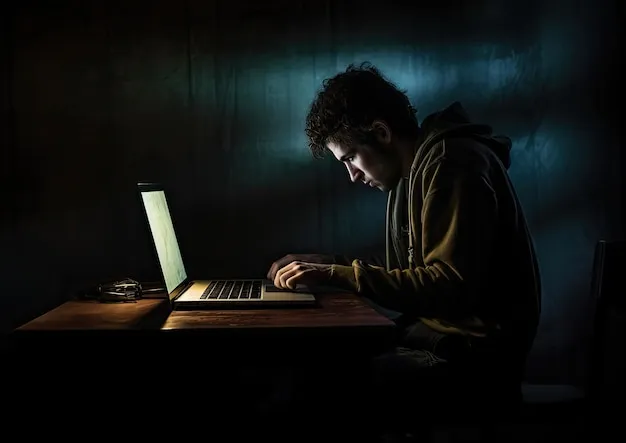
Photo: person watching computer screen alone at night glowing in dark room, via img.freepik.com
There's a specific kind of grief that doesn't have a name yet. It hits when a YouTuber you've watched for six years posts a "taking a break" video, or when a Twitch streamer you've tuned into every Thursday night quietly deletes their channel. You feel the loss in your chest — real, heavy, disorienting. And then comes the second wave: the embarrassment of feeling it at all.
You never met them. They don't know your name. And yet something real just ended.
Welcome to the parasocial void — that strange, signal-dense space where millions of Americans have quietly built some of their most consistent emotional relationships, not with friends or family, but with people who talk into cameras for a living.
The Architecture of a One-Sided Bond
The term "parasocial" was coined back in 1956 by sociologists Donald Horton and Richard Wohl, who were watching early television audiences develop what looked disturbingly like genuine friendships with TV personalities. The dynamic wasn't new, exactly — people had been writing love letters to radio hosts for decades. But the scale was different. The intimacy was different. And now, seventy years later, the technology has made it almost frictionless.
Dr. Crystal Abidin, a researcher who studies influencer culture, has described modern parasocial relationships as something qualitatively different from what Horton and Wohl observed. The old model was passive — you watched Johnny Carson, you felt like you knew him, but the signal only went one direction. Today's creators respond to comments, read superchats live on stream, quote tweet fans, share stories from their actual daily lives in real time. The illusion of reciprocity is nearly perfect.
That illusion is doing a lot of work.
"What makes this generation of parasocial bonds so sticky," says Dr. Pamela Rutledge, director of the Media Psychology Research Center, "is that the cues your brain uses to evaluate closeness — consistency, self-disclosure, emotional availability — are all present. Your nervous system doesn't really distinguish between a friend who texts you every day and a creator whose voice you hear in your earbuds for two hours every morning."
Your brain, in other words, is not confused. It's doing exactly what it evolved to do. It's just working with inputs it was never designed to process.
What the Void Is Actually Filling
Ask people why they follow certain creators so devotedly and you'll hear a version of the same answer dressed up in different clothes. It's usually something like: they get it. They understand something specific about your life — your humor, your anxiety, your niche interest in competitive cooking shows or indie horror games — that the people physically around you maybe don't.
In a country where studies consistently show Americans have fewer close friends than previous generations, that feeling of being understood isn't a small thing. It's enormous.
Jordan, a 27-year-old in Columbus, Ohio, told me he started watching a particular gaming streamer during the pandemic and kept watching long after lockdowns ended. "I was living alone, working remote, and just... nobody was around. His stream was on every night at eight. It sounds pathetic when I say it out loud, but it genuinely felt like going somewhere. Like having somewhere to be."
That language — having somewhere to be — shows up a lot in conversations about parasocial attachment. The creator's schedule becomes your schedule. Their milestones become events you anticipate. Their bad days register as your bad days.
This is where the comfort lives. And this is also where things can start to bend.
When the Signal Distorts
Not every parasocial relationship tips into something unhealthy. Most don't. Researchers generally treat them as a normal, even valuable, feature of modern media consumption — a low-stakes way to practice emotional connection, to feel part of something, to find community around shared interests.
But the architecture of creator culture creates specific pressure points that can make these bonds more complicated than they look from the outside.
Creators have enormous financial incentive to maximize intimacy. Every confessional video, every "I've never told anyone this before" moment, every tearful livestream is also, functionally, content. The line between genuine vulnerability and performed vulnerability is genuinely blurry — sometimes to the creator themselves. And audiences who've invested real emotional energy can feel profoundly betrayed when that line gets revealed.
There's also the issue of asymmetry becoming visible at the worst possible moments. When a creator you've followed for years is caught in a controversy, or goes through a public breakup, or just... changes in ways you don't recognize, the relationship you thought you had gets clarified in a painful way. You were always an audience member. The intimacy was always one-directional. The signal was always only going one way.
"The grief people feel in those moments is real," says Rutledge. "But it's also grief for something that never quite existed the way they thought it did. That's a specific kind of complicated."
Learning to Sit With the Static
There's no clean resolution to offer here — no tidy advice about healthy media habits that doesn't sound patronizing. The parasocial void exists because something real is missing from a lot of people's lives, and pointing at the symptom doesn't fix the underlying condition.
What might actually be useful is just... naming it. Acknowledging that these bonds have real emotional weight without treating that weight as a personal failure or a sign of dysfunction. You're not broken because you cried when your favorite podcast ended. You're not embarrassing because you felt genuine excitement watching someone open mail for an hour. These are human responses to human-shaped content, delivered with precision into the most intimate spaces of your daily life.
The void broadcasts. You receive. Something happens in that exchange that neither party fully controls.
Jordan still watches his streamer, by the way. Every Thursday. "I've got actual friends now," he said, laughing a little. "I still tune in. I don't think that's a problem anymore. It's just part of how I watch things."
Maybe that's the most honest place to land. Not with a diagnosis, not with a warning label — just with the quiet acknowledgment that we're all out here receiving signals from people we'll never meet, and finding, somehow, that it helps.